Night Covers vs Glass Doors in Product Refrigeration: Which Are More Effective
July 22, 2026
Choosing the right enclosure for commercial refrigerated display cases is a critical decision for modern retailers. Two main solutions address energy consumption, product integrity, and the customer experience: night covers and glass doors. While both options aim to reduce thermal loss and cut operational costs, they function differently across daily store operations. Read on to find out which is more effective at protecting your produce.
Understanding the Role of Night Covers and Glass Doors in Refrigerated Displays
Every open refrigerated display case battles ambient store air, which forces compressors to work harder to maintain safe holding temperatures. Retailers deploy barriers to mitigate this thermal transfer, but their operational windows differ significantly.
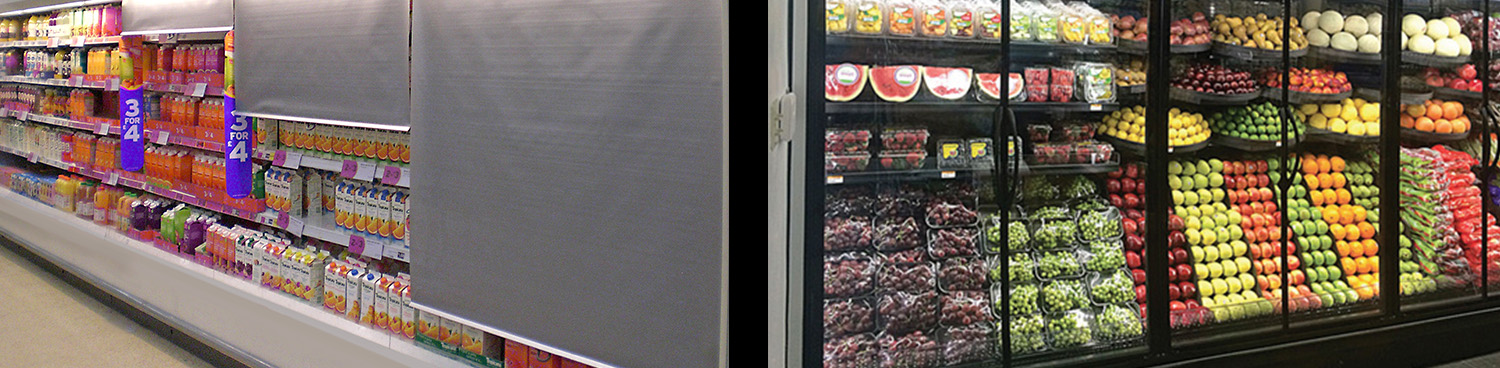
- Night Covers: Woven or aluminum-coated barriers pulled down manually or automatically only during non-operating hours to trap cold air.
- Glass Doors: Permanent, transparent physical barriers that remain closed 24/7 except when a customer retrieves an item or staff members restock the display.
How Night Covers and Glass Doors Differ in Temperature Control and Airflow
Maintaining a stable core product temperature relies entirely on managing the air curtain of a display case. An air curtain functions as a thermal barrier, continuously cycling cold air across the front opening to isolate the inventory from warmer ambient air. Disruptions to this airflow lead to temperature spikes and frost buildup.
- Air Curtain Protection: Glass doors eliminate ambient drafts, whereas night covers only protect the case when the store is closed, leaving the air curtain vulnerable during the day.
- Temperature Stability: Glass doors provide an unchanging microclimate; according to research, installing glass doors on open vertical cases reduces the average food product temperature by 3.3°C.
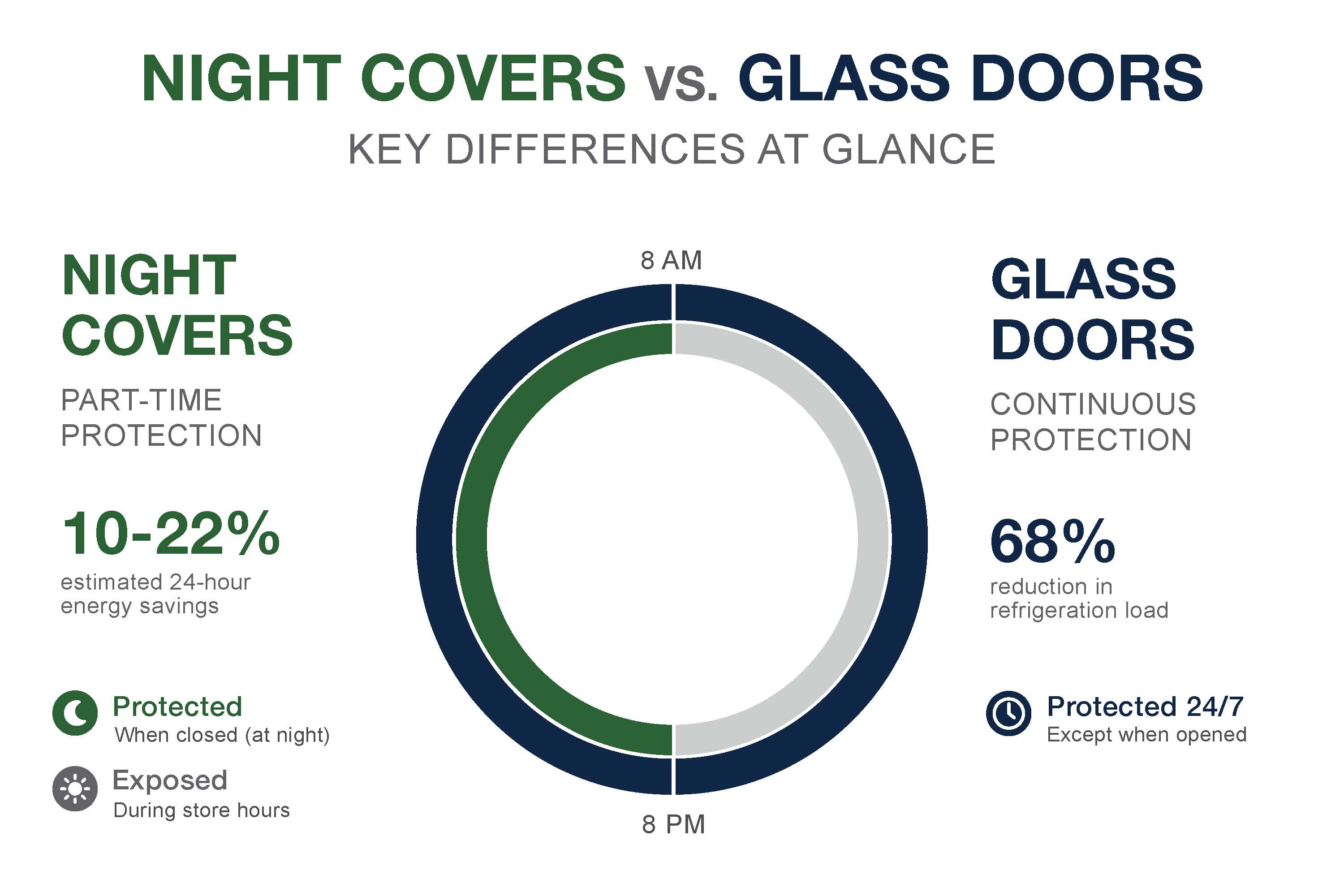
Night Covers vs. Glass Doors: Temperature & Airflow Comparison
| Comparison Feature | Night Covers (Night Blinds) | Glass Doors (Full Enclosures) |
|---|---|---|
| Primary Function | Part-time protection used strictly during non-operating store hours. | 24/7 continuous thermal physical barrier for both open and closed store hours. |
| Airflow Management | Temporarily isolates the air curtain at night; during store hours, the open air curtain remains fully exposed to room air. | Isolates airflow inside the cabinet; eliminates dependency on an open air curtain system entirely. |
| Ambient Draft Protection | Zero protection during business hours; HVAC drafts, ceiling fans, and shopper motion continuously disrupt internal air balance. | Shields the cabinet more continuously from all external cross-drafts, HVAC currents, and aisle air movement. |
| Product Temperature Stability | Fluctuates over a 24-hour cycle; stable at night, but experiences ambient warmth spikes during open daytime hours. | Constant microclimate; maintains a steadier internal temperature and lowers average core food temperatures (approximately 3.3°C reduction) around the clock. |
| Humidity & Frost Prevention | Moisture enters during daytime operations, leading to ice build-up on coils and frequent defrost cycles. | Seals out ambient moisture; drastically reduces coil frost accumulation and energy-intensive defrost frequency. |
| Operation Dependency | Requires human compliance; if store staff forget to pull them down at closing, energy and cooling benefits are lost. | Passive and automatic; doors self-close or are closed by shoppers, ensuring consistent protection. |
| Customer Impact vs. Cooling Balance | Prioritizes frictionless daytime shopping (impulse purchases) over maximum daytime refrigeration control. | Prioritizes maximum energy efficiency and product preservation, with a slight trade-off in direct reach-in accessibility. |
Energy Efficiency: Comparing Overnight Performance and Daily Operations
Energy savings are a massive driver for retrofitting refrigeration units, but the math changes depending on when and how the barrier is deployed.
Peak vs. Off-Peak Savings: A study on refrigerated display cabinets by the University of Kent indicates that night covers yield an overall 24-hour energy savings of roughly 10% to 22% when lowered for half the day. Glass doors, by contrast, lower refrigeration loads by 68% continuously.
HVAC Impact: Glass doors significantly reduce the "cold aisle" effect, lowering the store's overall heating bill during winter months compared to open cases with night covers
Impact on Product Freshness, Accessibility, and Store Operations
An effective barrier must balance mechanical efficiency with the realities of the retail floor, including shelf life and user friction.
- Shelf Life: The superior, uninterrupted temperature control of glass doors extends the shelf life of perishables like meat and dairy more effectively than night covers. However, because produce dries out quickly in glass-door refrigerated cases, a fogging system is essential.
- Frictionless Shopping: Open cases with night covers allow completely frictionless shopping during the day, whereas glass doors introduce a physical barrier that may deter impulse buys.
- Labor Requirements: Night covers require daily staff discipline to deploy and retract, while glass doors require regular cleaning to remove fingerprints.
- Hygiene: Some customers do not like to touch door handles that have been handled by previous customers.
- Aisle Space: Opening glass doors takes up valuable aisle space.
Choosing the Right Solution for Your Store Environment
The ideal choice depends on your store's operating hours, product mix, and long-term capital expenditure budget.
- 24-Hour Operations: For round-the-clock supermarkets, night covers are virtually useless; glass doors are the only viable energy-efficient solution.
- High-Volume Impulse Zones: For convenience stores or high-turnover grab-and-go sections, open cases paired with night covers preserve quick access while saving energy during closed hours.
- Budgetary Constraints: Night covers offer a much lower upfront cost and are easier to retrofit, while glass doors require a higher initial investment but yield a faster, more substantial ROI.
Ready to slash your commercial refrigeration costs? Contact us today for a customized energy audit and find the perfect enclosure solution for your store layout.
If you found this article helpful please share it with your social media channels.
About
Prodew is the leading manufacturer of perishable control equipment for supermarkets and food storage facilities.
We offer misting systems for fruit, vegetable and seafood displays, as well as display case humidity systems for produce, meat, seafood, mushroom, delicatessen and flower displays.
Prodew has over 30 years of experience in the design, manufacturing and sales of misting and humidity equipment for the retail and post-harvest industries. We are dedicated to manufacturing the highest quality products at the most competitive prices.
We control more than 80% of the market share in the USA and is the world-leader in the produce misting industry. Look below to discover how we can help your company extend the shelf life of your perishables and maintain the freshness of your products.

Products
Misting
Humidification
Night Covers
Ice Melting
Water Solutions
Industries
Retail
Storage
Transportation
Agriculture
Other Industries
Service
Blog
Contact
Hours:
M-F 8:00 – 5:00 (except holidays)
Headquarters - USA
1359 Gresham Road, Marietta, Georgia 30062
Phone:
770-420-3060
Email:
sales@prodew.com
find us on:


